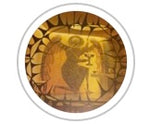
Masami Akita a.k.a Merzbow.
Original Solvent-Transfer art.
Tokyo, Japan: Masami Akita, 1982.
Unbound / Staple-bound softcover.
1 sheet / 36 sheets = 37 sheets.
Japanese and English.
Very good.
Single unbound sheet has two closed tears middle right, one longer than the other and two short closed tears middle left, all in the margin. Soft creasing. Japanese writing bottom right wishing a happy new year. Akita's address stamp bottom left.
Bound sheets are different sizes and types of paper. Minor corner wear. Soft creasing appears throughout. The front cover has a tear middle right, visible in photos and the twelfth sheet has a closed tear. The artwork is made by rubbing an image, from say a magazine, onto a sheet of paper that has been doused with a solvent. Viewed from the back, friction marks are visible on many sheets, this may explain the two tears.
1 unbound sheet and 36 sheets of staple-bound unique original solvent-transfer art by Japanese noise artist Masami Akita a.k.a Merzbow. Sent to mail artist Alex Igloo, publisher of Smegma magazine, in 1982 for inclusion in a mail art exhibition and as a New Years gift.
The Merzbow project began in 1979 and visual art such as this volume contains is extremely rare.
People: often women, sometimes clothed, often not, and one sheet Alice Cooper, the whole band. Artful and studied use of space, surprising color, beautiful abstractions, and great use of various shades of the color blue. Attractive unintended bleed visible on verso of many sheets.
Front cover has Akita's address rubber-stamp and a "Mail Art" rubber-stamp which has English and Japanese writing. On the back cover, it says "For Alex Igloo International Mail Art Exhibit" and on the bottom "1982 Masami Akita" alongside a rubber-stamp which says "Akita" in Japanese writing. Rubber-stamps are used through the volume, including on one sheet "Jupitter-Larsen had absolutely nothing to do with this...", referring to G.X. Jupitter-Larsen who founded the long-running U.S. Noise / Performance Art group The Haters in 1979.
"Merzbow stands as the most important artist in noise music. The favorite moniker of Japan appears on more than 500 albums. His name is taken from German artist Kurt Schwitters' Merzbau, and his choice of name reflects his fondness for junk art and his fascination with ritualized eroticism.
Akita was born in Tokyo in 1956. He grew up with psychedelic rock and began to play the drums in progressive rock bands, and with guitarist Kiyoshi Mizutani, who would remain a frequent collaborator. After high school, he studied literature and visual arts in college. There he discovered free jazz and seriously studied Dada and the surrealists (Salvador Dali was a big influence). Akita gradually withdrew from the rock scene and began experimenting in his basement with broken tape recorders and feedback.
In 1980, he created his own cassette label, Lowest Music & Arts, and released the first of many albums, Metal Acoustic Music. Infiltrating the then-burgeoning network of underground industrial music, he lined up one cassette after another, packaged in photocopied collage art. His harsh noise eschewed primitive anger to reach a Zen state, a calm inside the storm. Mizutani occasionally appeared on some of the raw material, as would other musicians, but in essence, Merzbow is Akita. The artist made low-budget live appearances in Tokyo, but his main focus remained on his art production and his writing.